Vasudhev-Kutumbkam
The Earth is one Family
The Green Kumbh Initiative
Kumbh Mela is a great opportunity to discover different dimensions of Indian spiritual life and contribute in making these mega events ecologically/socio-economically useful and sustainable. We aspire to make divine Kumbh as “Green Kumbh” by finding ways of minimising its environmental impact and maximizing its social-economic benefits.
As the world is facing increasing threats of Climate change, Wars, degradation of Human environment, so we are going to generate awareness about these issues among a large number of visitors/Media coming to attend forthcoming Kumbh festivals from all over the world.
"We request NGOs, thinkers, Corporate Social Responsibility (CSR) Professionals, International organisations, religious trusts and media to join us in this ongoing campaign."
Agenda for Forthcoming Kumbh Melas
We will be providing Quality Accommodation and food, guided trips and assistance to senior citizens and needy people to explore Kumbh Melas. Our major welfare activities during the Kumbh Mela are following:
Save Rivers Campaign
The rivers are the life-line of India and are worshipped by people in India. Most of the rituals of Hinduism are dependent on the waters of these sacred rivers.
During Kumbh Mela, we will organize programs to demonstrate the concept and importance of ‘water-quality’ in leading a healthy life.
Waste Management
During Kumbh festivals a large quality of solid and organic waste is generated. It consists of flowers, Clothing, Hoardings, Banners, waste food material, materials used in Rituals, Vegetables and Kitchen waste.
We will provide alternative for plastic uses and find ways of disposing organic and Non-biodegradable waste generated in these events. We will find ways to convert this waste into some useful substances.
Assistance for the Needy
We will have a team of well trained volunteers to extend full-fledged assistance to Senior citizens, differently abled and foreign delegates to explore Kumbh Mela.
Welfare Activities
While participating in Kumbh Melas, one can indulge in various spiritual activities:
- Service in and special need ashram (Leprosy, Blinds, Widows).
- Donation to Sanskrit university/Ashrams/Gaushalas.
- Bhandaras (Distribution of free food).
- Distribution of drinking water, Eco-friendly begs, clothes etc.
Special Pavilion
We will establish beautiful Pavilions in Mela Ground to showcase cultural and Spiritual heritage of India to visitors.
This pavilion will also have stalls for local artists to showcase their handicrafts and other local products and find opportunities for trading with visitors.
Research Activities
We are planning to conduct research on different aspects of Kumbh Mela in collaboration with Indian and foreign universities to measure impacts (social, spiritual and environmental) of this mega event.
We cordially invite researchers from all over the world to conduct research on different dimensions of this spiritual gathering.
Kumbh Melas Dates (2027 to 2037)
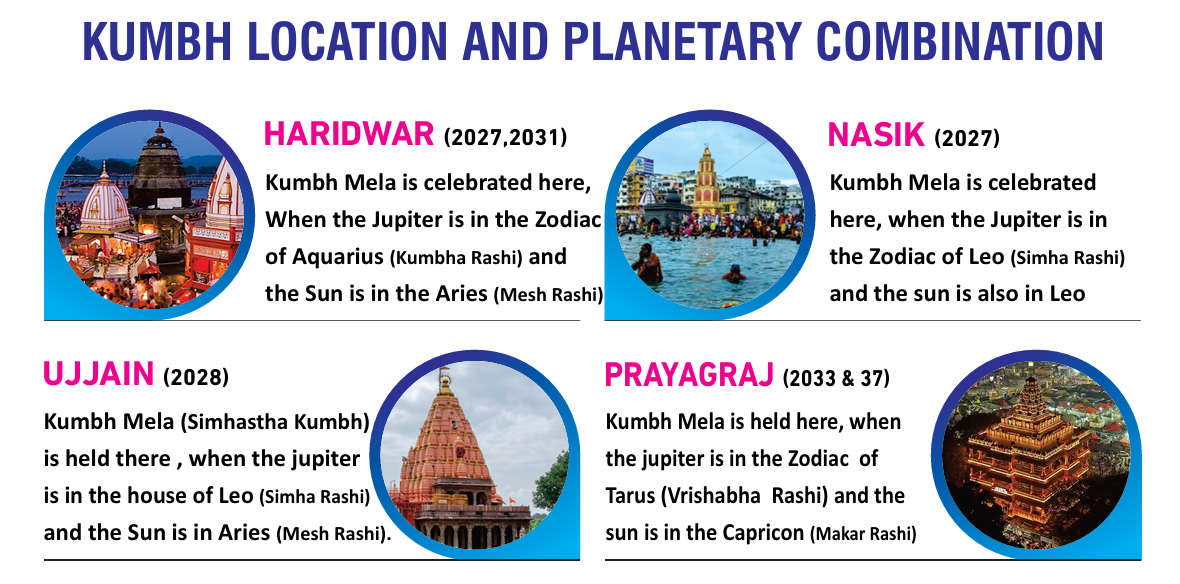
Kumbh Mela is organized at only these four sacred places (Haridwar, Nashik, Ujjain and Prayagraj) and is held according to the specific celestial positioning of Jupiter, the sun and the moon.
| Kumbh Location | Dates | Sacred River |
|---|---|---|
| Haridwar Ardh-Kumbh | 14 Jan - 20 April , 2027 | Ganges |
| Nashik Purna Kumbh | 24 July - 15 Sept, 2027 | Godavari |
| Ujjain Purna Kumbh | 27 March - 27 May, 2028 | Shipra |
| Prayagraj Ardh-Kumbh | 15 Jan - 14 Feb , 2031 | Ganges and Yamuna (Sangam) |
| Haridwar Maha Kumbh | 15 Jan - 14 Feb , 2033 | Ganges |
| Prayagraj Purna Kumbh | 14 Jan - 15 Feb , 2037 | Ganga and Yamuna (Sangam) |
Visitors are requested to remain in contact with us to get latest updates about Snaan (bathing) dates and other events.
ॐ Spiritual & Welfare Participation
While participating in Kumbh Melas, one can indulge in various spiritual activities. Some of the suggested activities are as follows:
Participation in the River conservation, Plantation and Waste management.
Service in and special need ashram (Leprosy, Blinds, Widows).
Donation to Sanskrit university/Ashrams/Gaushalas.
Donation for maintenance of Ghats (Banks of the Rivers) for pilgrims.
Volunteer work with organisations.
Bhandaras (Distribution of free food).
Healthcare for pilgrims.
Distribution of drinking water, Eco-friendly begs, clothes etc.
Research & Academic
Collaborations
We cordially invite researchers from all over the world to conduct research on different dimensions of this spiritual gathering. We will provide all ground support to research teams and individual scholars in their work.
Few of the possible areas of research are following:
- Indian spiritual traditions
- Different sects of Sadhus in India
- Significance of the Rivers in religious events
- Hindu Rituals
- Akharas and their functionality
- Hindu Philosophy and its Schools
- Crowd Management
- Visitor Experience
- Temporary Townships and their supply Chain and Impacts
- Globalization of Indian spiritual traditions
- Economics of spiritual events
- Amazing life styles of Sadhus (Monks)
The Meaning & Astrological Significance
Kumbh Melas are grand festivals celebrated at the most sacred towns of India to discover its spiritual grandeur and some of the oldest living traditions of Humanity . ‘Kumbha’ is a Sanskrit word meaning a Pot (Vase) of specific design, traditionally made by a particular community called Kumbhars (Potters) also known as Prajapatis . While the word ‘Mela’ means 'a Gathering' or 'a meet', or simply a fair .
The planet Jupiter plays a pivotal role in the calculation of place and time for celebrating Kumbh Mela . Jupiter takes approximately 12 years to complete its revolution around the sun, so approximately once in twelve years the sun earth and Jupiter align the same way as they were aligned during the great churning of the ocean done by Gods and demons .
When one takes a dip in the holy waters during this period of Kumbh, it is believed that energies through the water can effect a positive change in the mind, body and spirit of human beings, in other words cleanses the life free of the sins .
The Epic Tale of Samudra-Manthana
This mythological event of extracting the nectar from the ocean is called ‘samudramanthana’ because the word ‘Samundar’ literarily means the ocean and Manthan means ‘Churning’.
The Churning of the Ocean
Devas formed an alliance with Asuras to jointly churn the ocean for the nectar of immortality and to share it among them . Mount Mandarachala was used as the churning rod, and Vasuki, the king of serpents, became the churning rope . Vishnu in his second incarnation, in the form of a turtle Kurma, came to their rescue and supported the mountain on his back .
The Sacrifice of Shiva
During the churning, a deadly poison (Halahala) emerged that terrified the gods and demons because it was so toxic it might have destroyed all of creation . Out of compassion for all living beings, Shiva swallowed the poison in an act of self-sacrifice . The poison was stuck in Shiva's throat, changing its color to blue, earning him the name Nilakanta .
The Nectar of Immortality
Finally, Dhanvantari emerged holding the pot containing Amrita, the heavenly nectar of immortality . To drink this nectar a fierce battle commenced between Devas and Asuras, and during this fight a few drops of the nectar fell on earth at Prayag, Haridwar, Nashik, and Ujjain .
Sadhus and the Historic Akhadas
'Akhada' is a distorted form of the word 'akhand', which literally means a complete organisation . When Hindu Dharma came under ideological threat, they raised weapon-wielding brigades to repel the foreign invasions and named them Akhadas .
Life Styles of the Monks
- Naga Sadhus: Traditionally living as mercenary soldiers, they remain naked year-round or practice the most severe physical discipline .
- Urdhwavahus: Those who believe in putting the body through severe austerities to get salvation .
- Shirshasins: Those who meditate for hours standing on their heads .
- Kalpvasis: Those who spend the entire month of Kumbh on the banks of the Ganga, meditating, performing rituals and bathing thrice a day .
"In the Year 1855, during the Kumbh Mela at Haridwar, Oumanandji and His Guru Purnanandji prepared a blueprint for the First War of Independence against the British rulers in the Year 1857 ."